Gyeonggi Province is ending one of its own childbirth-related benefits, but the change is narrower than “all birth incentives have been abolished.” The affected programme is the Gyeonggi postpartum care grant of KRW 500,000 per newborn.
The province says applications received through September 30, 2026 will be processed under the existing rules, after which the provincial programme ends. National benefits and independently funded city or county programmes must be checked separately.
Action point: an eligible family with a child already born should not rely only on the normal 12-month application window. The programme-level deadline of September 30 comes first.
All images are AI-generated explanatory illustrations. They are not government notices, local-currency cards or photographs of a specific family.
What ends and what does not
| Benefit type | Position after September 2026 |
|---|---|
| Gyeonggi postpartum care grant | Applications through September 30, then ends |
| National First Meeting Voucher | Separate national programme |
| Parental benefit and child allowance | Separate national programmes |
| City or county birth grants | Rules and continuity vary by municipality |
| Locally funded postpartum support | Must be checked with the municipality |
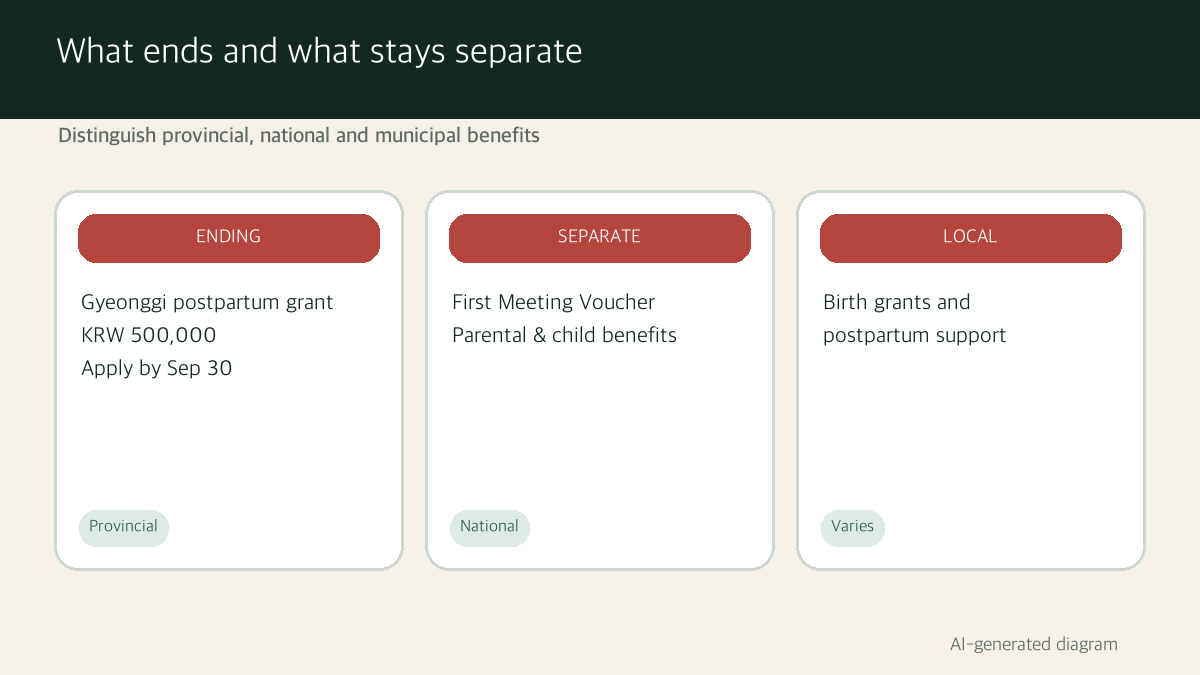
AI-generated policy diagram, not an official notice or payment card.
What the provincial grant currently covers
Gyeonggi’s programme page describes a payment of KRW 500,000 in local currency for each newborn. Multiple births are calculated by the number of children.
The published baseline conditions include:
- the infant’s father or mother actually resides in Gyeonggi on the application date;
- the infant is less than 12 months old on the application date; and
- the birth is registered in Gyeonggi.
The official routes are the community service centre responsible for the birth registration and the Gyeonggi Minwon 24 online service. Family status, foreign-national cases and unusual residence arrangements may require direct confirmation.
The controlling deadline is the application date
The provincial announcement says support will be provided for applications received by September 30 and then discontinued.
That means a child may still be within the ordinary 12-month window but lose access if the family waits until October. An application submitted by the deadline must still pass the existing eligibility review; the deadline alone does not guarantee approval.
Keep the online completion screen or receipt number. If the status is unclear or documents require correction, contact the relevant community service centre or public health centre rather than assuming the application is complete.
Why Gyeonggi is ending the programme
The province links the broader maternal-health restructuring to an unprecedented fall in tax revenue, fiscal pressure and expenditure consolidation. For this grant, it also points to the expansion of similar support through the national First Meeting Voucher and municipal birth grants.
Gyeonggi says it is shifting the priority of its maternal-health portfolio toward core areas such as infertility support. The official explanation therefore combines:
- lower revenue and fiscal pressure;
- consolidation where national or municipal benefits overlap; and
- a policy-priority shift within maternal health.
For households, however, the practical result is still the loss of a KRW 500,000 provincial benefit per newborn.
If the baby is due in October or later
A child born after the programme deadline cannot be birth-registered and applied for by September 30. Families should instead build a separate checklist for:
- the national First Meeting Voucher;
- parental benefit and child allowance;
- the resident city or county’s own birth grant;
- national eligibility for maternal and newborn health-management services; and
- any locally funded postpartum support.
Similar programme names do not mean the funding source is the same. A municipal benefit can continue even when the provincial contribution ends.
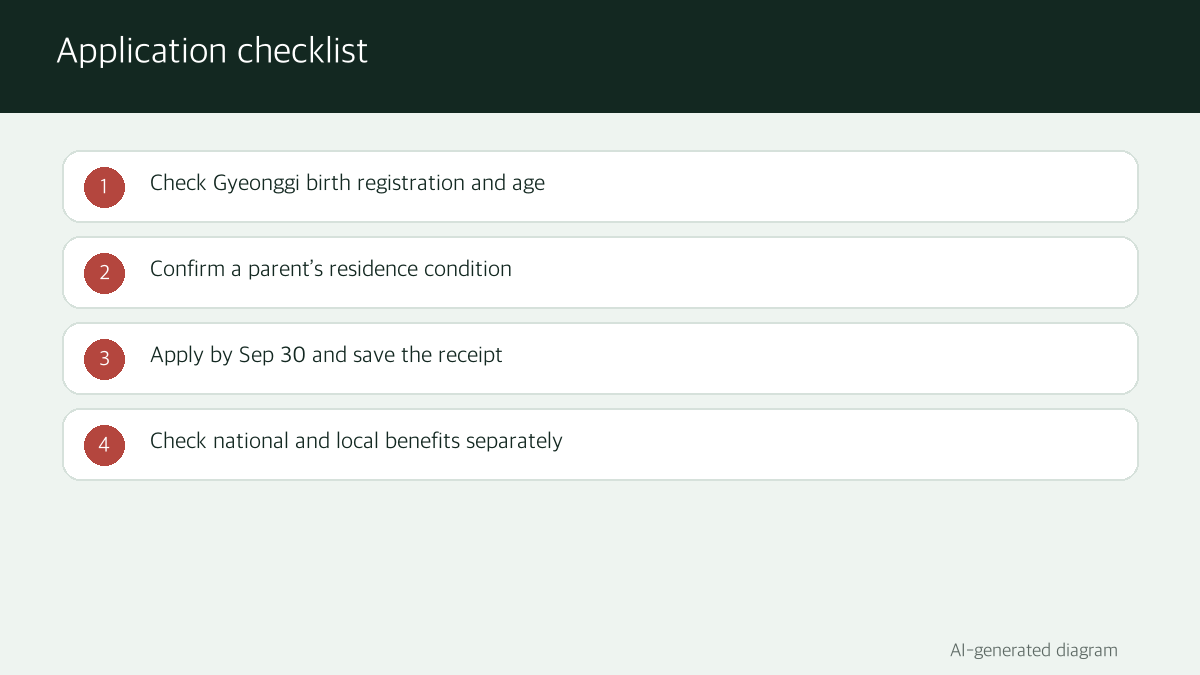
AI-generated checklist, not a screenshot of Gyeonggi Minwon 24.
Application checklist before September 30
- [ ] Confirm that the birth is registered in Gyeonggi.
- [ ] Confirm that the child is under 12 months old on the application date.
- [ ] Check the actual-residence condition for a parent.
- [ ] Choose Gyeonggi Minwon 24 or the responsible community service centre.
- [ ] Ask the public health centre about any exceptional family or nationality case.
- [ ] Save the completion screen or receipt number.
- [ ] Check local rules for payment and use of the local currency.
Other maternal-health programmes in the restructuring
The same provincial announcement also discusses changes to additional maternal-and-newborn health-management support, medical costs after discontinued fertility treatment, and egg-freezing procedure support. Their final eligibility dates may differ, so do not apply the postpartum-grant deadline to every programme.
Frequently asked questions
Is every childbirth incentive in Gyeonggi ending?
No. The announcement confirms the end of specific provincial programmes. National benefits and city or county benefits remain separate decisions.
What if the child is already born but the family has not applied?
Check the existing conditions and submit by September 30 through Gyeonggi Minwon 24 or the responsible community service centre.
Does submitting on September 30 guarantee payment?
No. The application must also satisfy the residence, birth-registration and age conditions. Confirm receipt if there is any uncertainty.
Bottom line
The change is not a blanket abolition of all birth benefits. It is the end of the Gyeonggi KRW 500,000 postpartum care grant after applications received by September 30, 2026.
Eligible families should act on the programme deadline now. Families expecting a later birth should separately verify national and municipal support instead of assuming that every benefit has disappeared.
A shorter Korean search-oriented application guide is available on the Life Mokcha Naver Blog.
About the Author
Life Mokcha’s editor, “Mokcha Keeper,” separates benefit eligibility, deadlines and funding levels using primary government sources. Confirm the current rule with the responsible authority before applying.