The same sofa may be hoisted outside an Amsterdam canal house, loaded into a rented truck in the United States, or packed and placed by one moving crew in Korea. These are not simple expressions of national character. Urban form, housing, contracts, address systems and service markets shape how people move.
This article begins with the Korean YouTube video “Why moving methods differ by country”, then checks its claims against direct sources and adds France, Germany, Singapore, and England and Wales.
Bottom line: Korea’s advantage is not one ladder truck. It is the ability to connect packing, protection, transport, lift or elevator coordination, placement and address registration as one coordinated workflow.
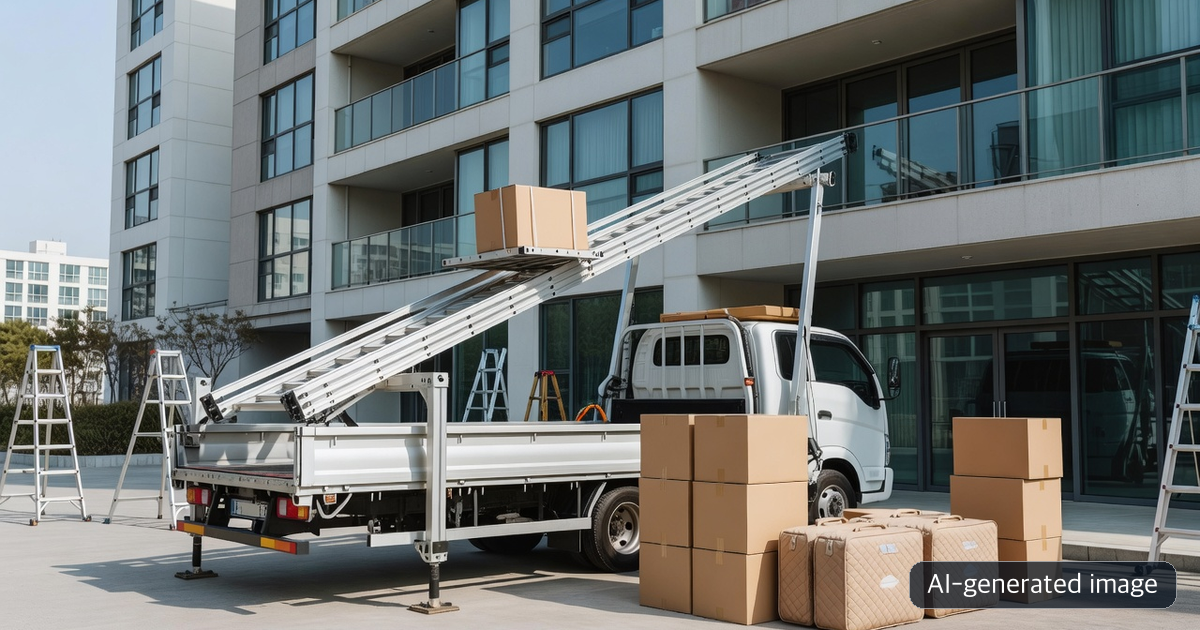
AI-generated explanatory image. It does not depict a specific company or actual move.
What the source video shows—and what needed correction
The 3-minute 37-second video contrasts four scenes.
| Timestamp | Example in the video | Verification boundary |
|---|---|---|
| 00:19 | Exterior hoisting at a Dutch canal house | The Museum of the Canals documents hoisting beams and pulley wheels. |
| 00:58 | Detailed wall and floor protection in Japan | A representative service scene, not a rule for every Japanese move. |
| 01:36 | A rented truck and DIY loading in the US | A major option, but professional movers also operate widely. |
| 02:25 | Korean ladder lifts and full-service crews | Distinctive in Korea, but exterior furniture lifts also exist elsewhere. |
The video’s implication that only Korea uses a furniture ladder is too broad. Paris has a formal road-occupation process for monte-meubles, or exterior furniture lifts.
Eight systems shaped by different constraints
| Country | Historical or institutional setting | Typical moving issue |
|---|---|---|
| Netherlands | Amsterdam’s canal expansion began in 1613; houses also served as warehouses and workshops | Exterior hoisting at narrow, tall canal houses |
| Japan | Moving demand concentrates in March and April | Capacity planning, reservations and surface protection |
| United States | A 1948–2025 geographic-mobility series and the video’s DIY example | DIY truck rental, containers and professional services coexist |
| France | Paris AOT rules for moving vehicles and furniture lifts occupying public space | Road permits for moving vehicles and furniture lifts |
| Germany | Residence is closely tied to municipal registration | Registering a new address within 14 days |
| Singapore | Large-scale public-housing transformation since 1960 | Elevator, common-area and building-management coordination |
| England and Wales | Interdependent buying and selling chains | Legal completion and key handover drive moving dates |
| South Korea | Mass apartment housing and a specialized packing industry | Crew packing, lifts or elevators, and placement as one workflow |
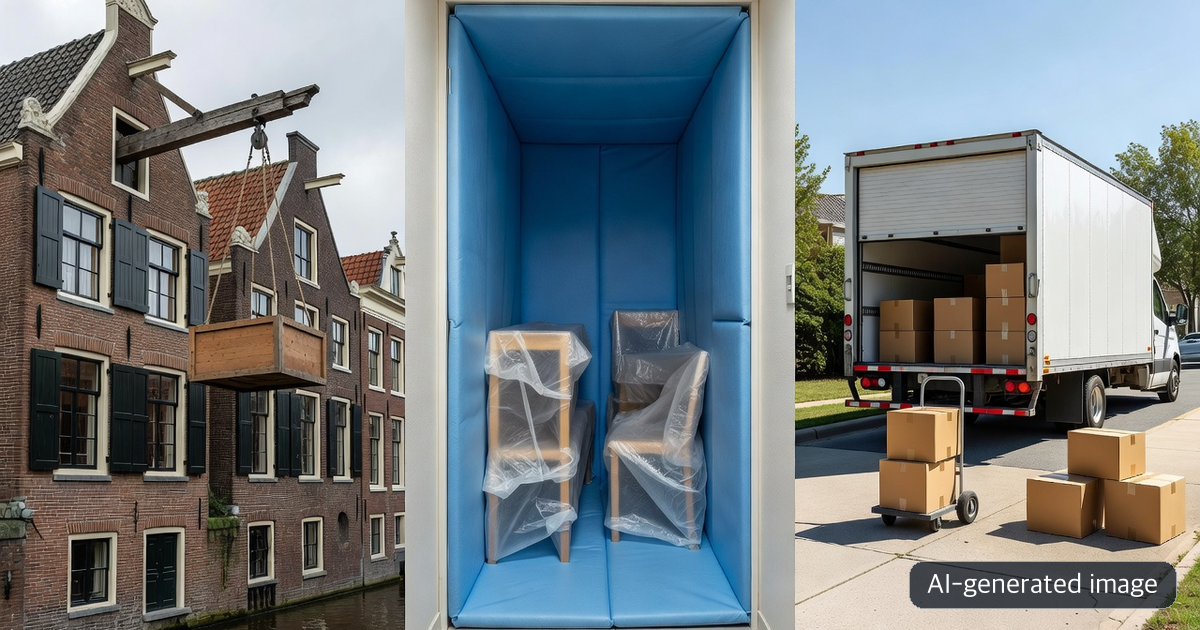
AI-generated comparison. No single image represents every move in a country.
Netherlands: canal architecture moved goods outside
According to Amsterdam’s Museum of the Canals, construction of three new canals began in 1613. Canal buildings combined homes with warehouses and workshops. The museum’s architecture guide describes eighteenth-century cornices that concealed beams and pulley wheels used to hoist goods.
The lesson is not that Dutch people prefer window moves. Tall, narrow buildings with commercial storage made exterior lifting practical. We have not repeated the familiar “façade-width tax” explanation as a fact because the direct museum sources reviewed here did not establish it.
Japan: March demand is about twice a normal month
Japan’s Kyushu District Transport Bureau, part of the Ministry of Land, Infrastructure, Transport and Tourism, says requests concentrate in March and April. Its February 2026 guidance states that March records roughly twice the number of moves seen in a normal month, making drivers and vehicles difficult to secure.
The detailed protective work shown in the video makes operational sense in this compressed market: surface protection and repeatable procedures help limit damage and disputes. Service levels still vary by company and contract.
United States: DIY is a large option, not the whole market
The US Census Bureau publishes geographic-mobility tables extending from 1948 through 2025. These tables do not reduce US moving to one rate or method; the video shows self-driven truck rental and DIY loading as one option.
Professional movers and portable containers coexist with DIY rental. Distance, budget and household size determine the mix.
Paris: an exterior lift starts with a street permit
The City of Paris requires temporary road-occupation authorization when moving vehicles or furniture lifts use public space. If a monte-meubles is involved, the application should be filed at least 15 days before the move.
Exterior lifts are therefore not unique to Korea. The meaningful difference lies in how public-space occupation and permits are managed.
Berlin: moving includes registering the residence
Berlin’s service portal says residents must register a new home within 14 days of moving in. Online registration is available under specified conditions; otherwise the process is handled at a citizens’ office. A landlord’s confirmation of occupancy is required.
The physical move and the administrative move form one experience.
Singapore: housing transformed by public housing after 1960
According to Singapore’s National Library Board, HDB built 21,232 units in its first three years while responding to a severe housing shortage, and completed 53,000 flats under its first five-year programme by the end of 1965. Early two- and three-room rental flats were also placed in blocks five to 12 storeys tall. This rapid expansion of multi-storey public housing helps explain why elevator use, common-area protection and building rules matter in modern moves.
Booking and protection requirements differ by property, so residents must check with the relevant building manager.
England and Wales: legal timing can control moving day
GOV.UK’s England and Wales guide says selling a home takes about five months on average and can take longer when the seller is part of a chain of buyers and sellers. Completion, payment and key handover may therefore determine the move more than the mover’s availability.
Korea: repeated apartment layouts built operational expertise
Korea’s 2024 Population and Housing Census reports that 53.9% of households lived in apartments. Repeated experience in similar multi-unit buildings has encouraged a specialized workflow:
- room-by-room packing at the origin;
- protection for floors, doors and elevators;
- site-specific choice between a furniture ladder lift and an elevator;
- coordination with building management, parking and loading paths;
- furniture and appliance placement at the destination; and
- optional cleaning, disposal and installation services.
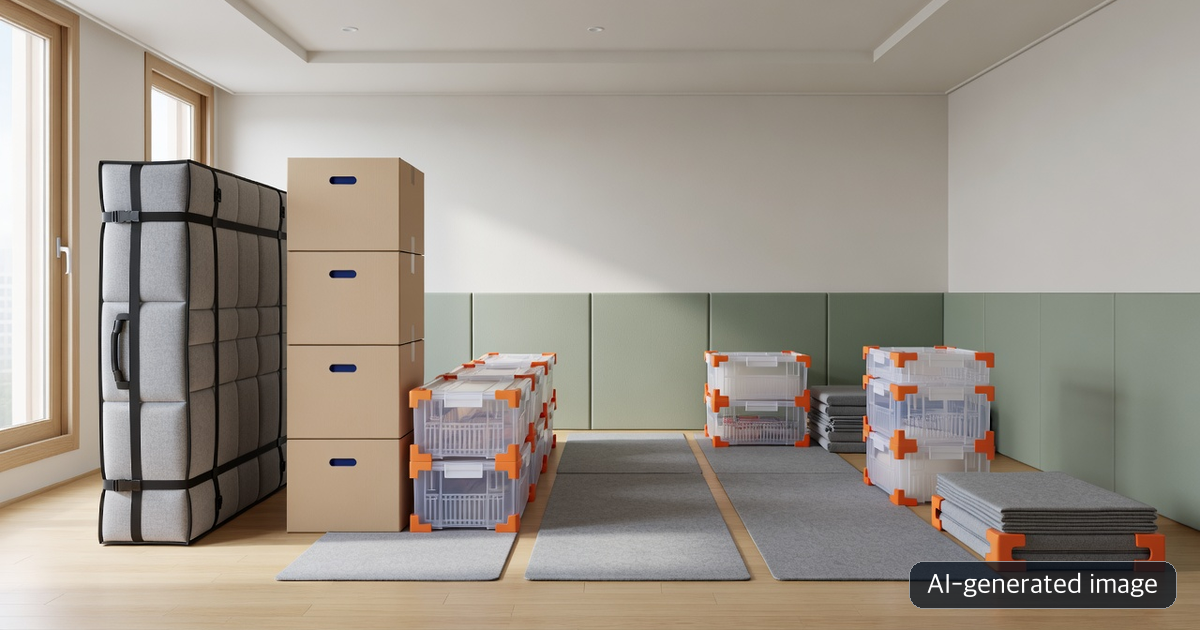
AI-generated explanatory image. Exact equipment and service scope vary by contract and site.
Korea’s Government24 service accepts change-of-address reports online or in person and lists processing as immediate, within three working hours. The report is due within 14 days of moving in, and online applications cannot be submitted by a proxy.
Korea’s strength is integration, not speed
There is no need to rank every national system. Amsterdam’s hoisting beam suits its canal houses; Paris manages public-space occupation through permits; Japan’s demand-spreading campaign addresses seasonal capacity.
Korea nevertheless has four practical strengths:
- Broad service scope. Packing, transport and placement can be purchased as one service.
- High-rise experience. Crews routinely assess floors, balconies, elevators, parking and access together.
- Multiple steps are joined into one workflow. Packing, protection, lift or elevator coordination, and placement are connected through a team service.
- Accessible administration. Address reporting can continue online after the physical move.
Quality is not universal. A written quote should identify crew size, elevator or ladder-lift fees, installation and disposal scope, damage compensation and possible surcharges.
Six-point moving checklist
- [ ] Reserve elevators and confirm working hours at both buildings.
- [ ] Check furniture-lift access and underground-parking height.
- [ ] Separate disposal items before requesting the final quote.
- [ ] Put surcharges, installation, disposal and compensation in writing.
- [ ] Carry valuables, documents and medication yourself.
- [ ] Track address, mail, internet and utility changes separately.
Moving cultures are not a league table of personal virtues. They are operating systems built by cities, homes and institutions. Seen in that context, Korea’s real advantage is clear: Korea’s strength lies in joining the complicated tasks of a high-rise move into one coordinated workflow.
Checked: 20 September 2026 KST
About the Author
Life Table of Contents Editorial Team
References
- Daily Soul English, Why moving methods differ by country
- Museum of the Canals, History
- Museum of the Canals, Architecture
- Kyushu District Transport Bureau, Request to spread moving dates
- US Census Bureau, CPS Historical Migration/Geographic Mobility Tables
- City of Paris, Parking during a move
- Service Berlin, Registration of a residence
- National Library Board Singapore, Public Housing, Private Lives
- GOV.UK, Selling a home
- Korean Ministry of Data and Statistics, 2024 Population and Housing Census
- Government24, Change-of-address report
- Read the Naver version