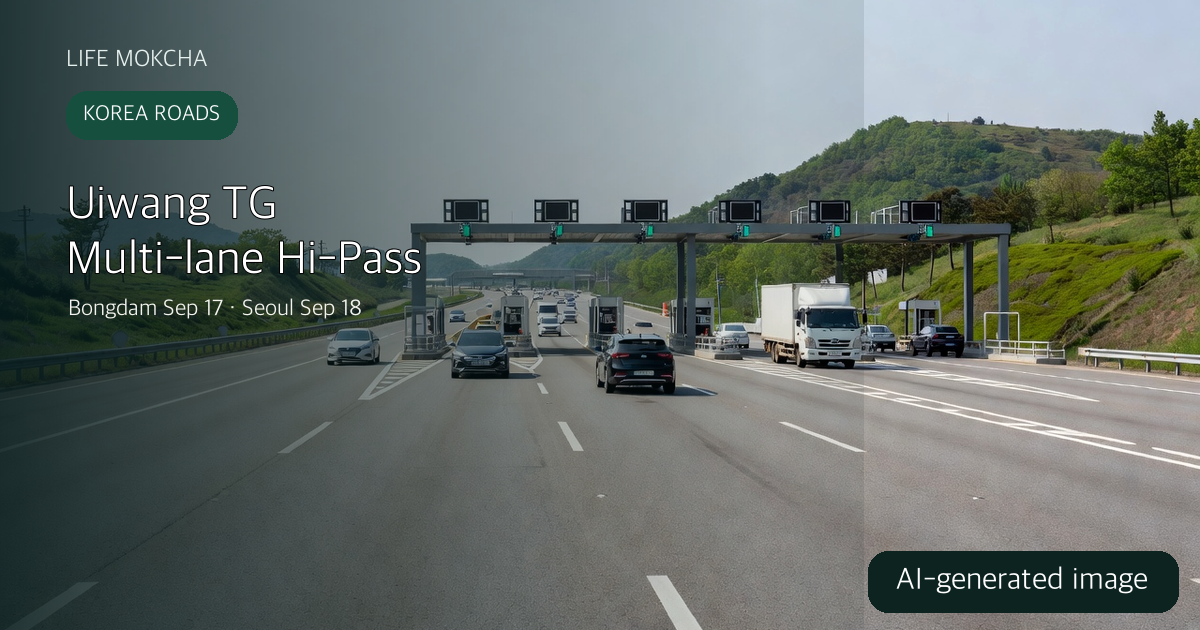
The multi-lane Hi-Pass trial at Uiwang Tollgate does not begin in both directions on the same day. According to Gyeonggi Province, the Bongdam-bound side starts on September 17, followed by the Seoul-bound side on September 18.
Driving priority: On the first trip, treat live speed limits, signals, lane-control displays, and road markings as more important than the
60 km/hfacility figure in the press release. Avoid a last-second lane change at the tollgate.
The change applies to Uiwang TG on the Seo-Suwon–Uiwang Expressway, which is Provincial Road 309. The reviewed government release does not announce a toll change.
All images are AI-generated editorial illustrations. They do not show the real Uiwang tollgate, current signs, construction conditions, or live traffic.
Start with the direction schedule
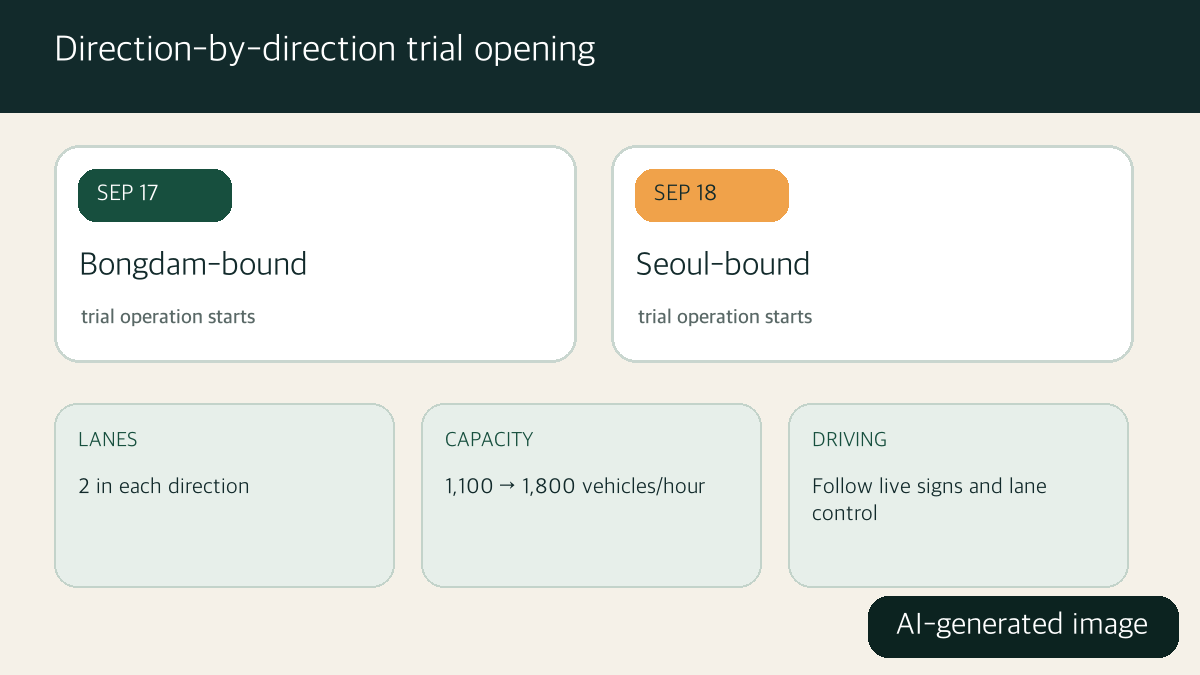
Editorial diagram built from the official dates and figures. It is not a photograph of road signs or lane geometry.
| Direction | Start date | Stage |
|---|---|---|
| Bongdam-bound | September 17, 2026 | Trial operation begins first |
| Seoul-bound | September 18, 2026 | Trial operation begins the next day |
Kyeonggi Ilbo reported that the two directions were scheduled to open sequentially at noon on their respective dates. Lane-switching, pavement marking, and traffic control may affect the field schedule, so a live display or traffic controller should take priority over a published time.
What a multi-lane Hi-Pass changes
A conventional single-lane Hi-Pass funnels vehicles into one narrow channel. A multi-lane installation removes barriers or posts between adjacent electronic-toll lanes, creating a wider, mainline-like non-stop tolling zone.
At Uiwang TG, the project installed two multi-lane Hi-Pass lanes in each direction. Gyeonggi Province and the private-road operator also reported work on:
- straightening the lane alignment;
- reinforcing safety facilities; and
- repainting signs and lane markings.
A wider tolling area does not eliminate the need to choose and hold a safe lane. If you miss the preferred approach, do not cut across several lanes immediately before the gantry; follow the live lane guidance.
Separate facility performance from a speed instruction
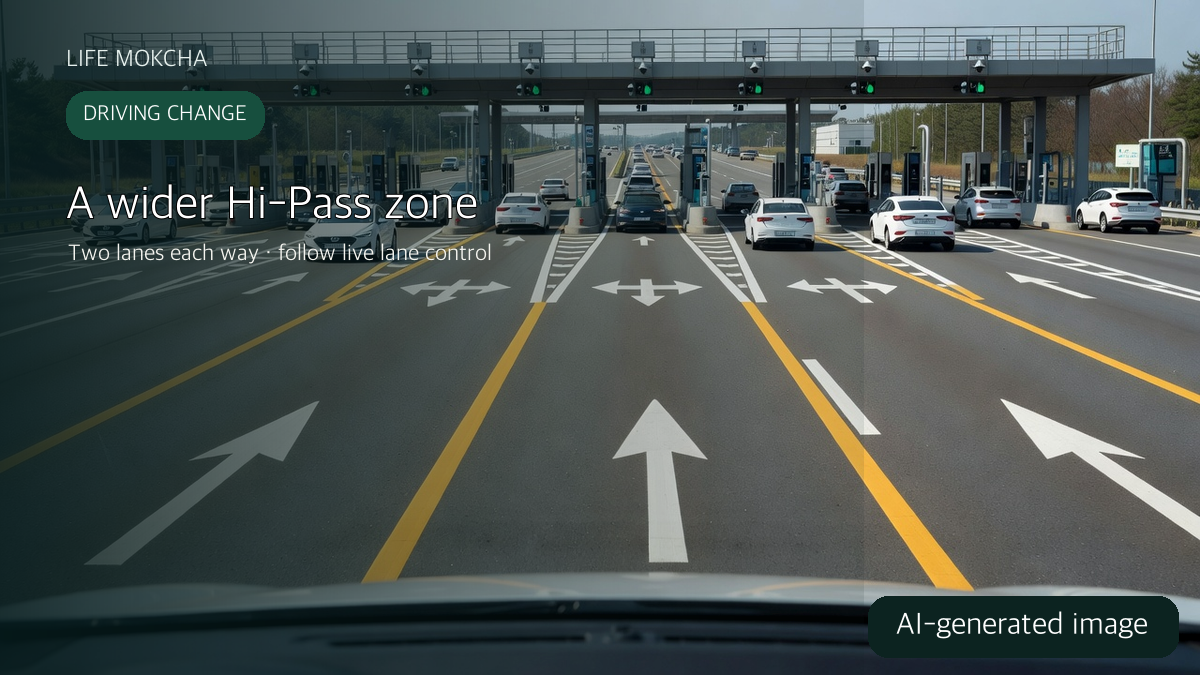
AI-generated illustration. It is not the actual lane, signal, or traffic state at Uiwang TG.
The province says the facility's passage speed improves from 30 km/h to 60 km/h, while estimated capacity rises from 1,100 to 1,800 vehicles per hour—an increase of more than 60 percent.
Read the figures carefully:
| Announced figure | What it describes | What it does not mean |
|---|---|---|
| 30 → 60 km/h | Improvement in toll-zone flow | An instruction to drive at 60 km/h in every condition |
| 1,100 → 1,800 vehicles/hour | Estimated processing capacity | A guarantee that congestion immediately disappears |
| Two lanes each direction | Size of the multi-lane installation | Every lane at the toll plaza is Hi-Pass |
Drivers must still obey the posted limit, green or red lane signals, closure displays, and the actual space to the vehicle ahead. A system-design figure never overrides live traffic control.
Four decisions on the first trip
1. Confirm the direction and date
Bongdam-bound operation begins first on September 17. The Seoul-bound side follows on September 18. Do not assume the opposite side has opened merely because one direction is operating.
2. Expect temporary lane arrangements
The local newspaper reported that lane-conversion and painting work would be needed across September 17–18. If cones, temporary lines, or traffic-control vehicles are present, follow the temporary arrangement rather than an old driving habit.
3. Hold a stable path through the wider zone
More lateral space is not permission to weave. Check the Hi-Pass device and payment card before departure, establish the approach lane early, keep a safe gap, and avoid sudden steering within the tolling zone.
4. Treat toll changes as a separate announcement
The provincial release explains the facility and capacity but does not announce a toll increase, reduction, or payment-system change. Do not infer a discount from the multi-lane opening.
One-minute pre-drive checklist
- [ ] My route actually passes Uiwang TG on the Seo-Suwon–Uiwang Expressway.
- [ ] I know whether I am Bongdam-bound or Seoul-bound.
- [ ] I checked the trial start date for that direction.
- [ ] My Hi-Pass device and payment card are ready.
- [ ] I will follow live limits, displays, and markings.
- [ ] I will not make a sudden lane change in the wider zone.
- [ ] I will only treat toll terms as changed after a separate official notice.
Bottom line
The essential facts are: one tollgate, different start dates by direction, two multi-lane lanes each way, and a projected capacity improvement. The Bongdam-bound trial starts September 17 and the Seoul-bound trial September 18.
The performance figures explain why congestion may improve. Safe use during the transition still depends on live signage, adequate following distance, and predictable lane movement.
A shorter Korean search-oriented version is available on Life Mokcha's Naver Blog.
About the Author
The Life Mokcha editor separates road-facility performance figures from the actions a driver should take. During trial openings and construction transitions, current lane-control displays and operator instructions should take priority.