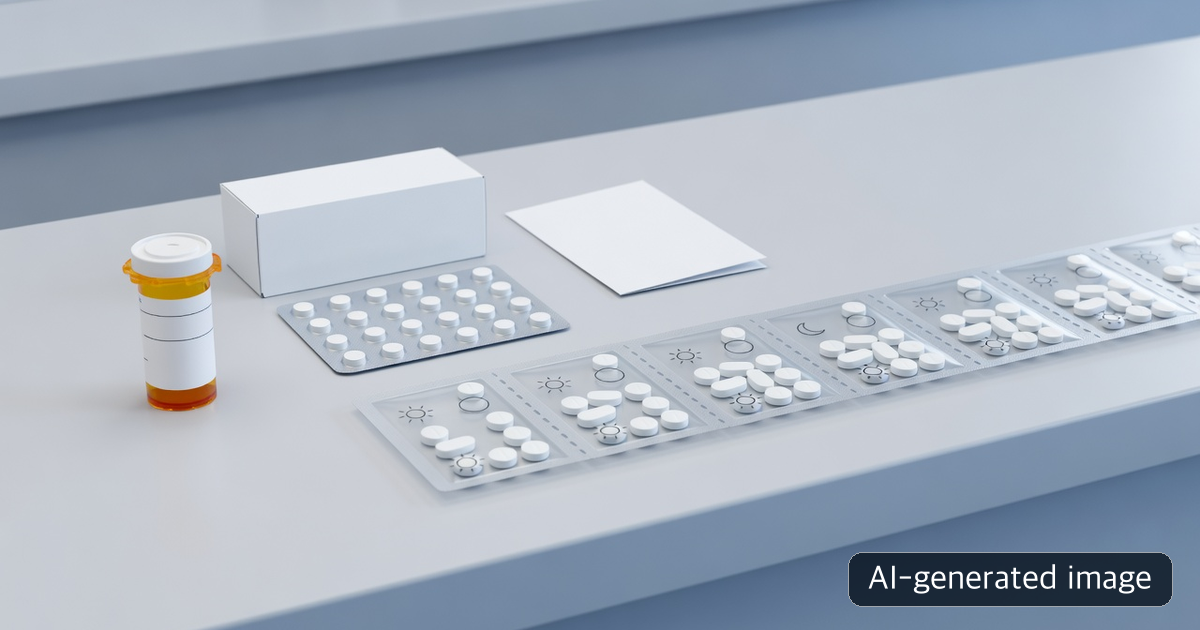
The orange vial seen in American television, the manufacturer box and blister associated with parts of the UK system, Japan’s 一包化 service, and the morning–noon–night pouches familiar in Korean pharmacies all contain medicine—but they solve different operational problems.
National character is a poor explanation. Child-resistant packaging law, preservation of manufacturer information, pharmacist-led medication support, separation of prescribing and dispensing, and automation all shape the final package.
This guide starts with the Korean YouTube video “Why the US uses pill bottles while Korea uses pouches”, then checks the comparison against official US, UK, Japanese, and Korean sources and research on automated dose dispensing.
Bottom line: Korea’s advantage is not a thin pouch by itself. It is the connection of prescription review, Drug Utilization Review (DUR), pharmacist counselling, and organisation by administration time. Manufacturer packaging still has important advantages in information, protection, and traceability.
Four systems prioritise different problems
| Format | Main operational priority |
|---|---|
| US-style vial | Counting the prescribed quantity and child-resistant closure |
| UK original-pack policy | Retaining manufacturer packaging and the patient information leaflet while reducing repacking |
| Japan’s one-dose service | Medication-management support for patients who meet specified needs |
| Korea’s pharmacy pouches | Organising multiple medicines around the patient’s actual administration times |
This is not a claim that every prescription in a country follows one format. Original packs are also used in the US; some UK prescriptions require an exact quantity; and Japanese and Korean pharmacies must account for dosage form, stability, the prescription, and the patient.
United States: child resistance is not the same as tamper evidence
The US Consumer Product Safety Commission says the Poison Prevention Packaging Act of 1970 requires certain substances to use “special packaging.” The package must be significantly difficult for children under five to open within a reasonable time, without being difficult for adults to use properly.
A prescription drug may be dispensed in non-child-resistant packaging at the specific request of the prescriber or patient. This is an accessibility exception, not a recommendation for households with children.
Tamper evidence is a separate safety layer. According to the FDA’s historical account, seven people in Chicago died after ingesting cyanide-laced Tylenol capsules in 1982. The FDA issued tamper-resistant packaging requirements that year, and the Federal Anti-Tampering Act followed in 1983.
- Child-resistant packaging makes access difficult for young children.
- Tamper-resistant packaging provides visible evidence when a barrier has been breached or is missing.
The terms should not be treated as synonyms.
United Kingdom: an original-pack example, not a rule for all Europe
Europe does not have one uniform community-pharmacy packaging practice. The UK provides a bounded official example.
A 2023 UK government consultation response described regulatory changes intended to let a pharmacist dispense up to 10% more or less than the prescribed quantity when that would preserve the original pack. The stated aims were to retain the patient information leaflet and reduce the time spent splitting boxes, snipping blisters, and repacking medicines.
The same document emphasised responsible-pharmacist judgement. Some courses of antibiotics or steroids may require the exact prescribed quantity. It also noted that application within National Health Service pharmaceutical services involved administration-specific arrangements.
The value of an original pack is therefore more than a tidy box. It can preserve manufacturer information, protective design, and product identity.
Japan: one-dose packaging as conditional medication support
Japan’s Ministry of Health, Labour and Welfare described 一包化 in its 2022 dispensing-fee reform. The service supports patients taking many medicines or those who have difficulty removing them from packages.
With the prescriber’s agreement, the pharmacist packages internal medicines by administration time, provides necessary counselling, and supports medication management. The reform material also describes a criterion involving at least two internal medicines, or at least three types within one medicine, organised by administration time.
This is more accurately described as a needs-based medication-support service than as a universal Japanese packaging culture.
Korea’s first strength: dispensing and counselling belong together
Article 2 of Korea’s Pharmaceutical Affairs Act defines dispensing to include combining medicines or dividing one medicine into fixed quantities for a specified person and regimen.
The same article defines medication counselling to include information about the medicine’s name, directions and dose, effects, storage, adverse effects, interactions, and appearance. Article 24 requires a pharmacist who dispenses medicine to provide necessary counselling orally or through a written or electronic guide.
Dividing medicines into pouches is therefore not the end goal. The patient must also understand what the medicines are, when to take them, and how to store them.
The 2000 separation of prescribing and dispensing
The Ministry of Health and Welfare’s implementation announcement set 1 July 2000 as the start of Korea’s separation of prescribing and dispensing. As a general rule, outpatients would be examined and prescribed medicine by a medical institution and have it dispensed at a pharmacy, with defined exceptions for patients, regions, and products.
That policy expanded the pharmacy’s dispensing role, but it does not by itself prove how quickly automated pouch machines spread. The verified chronology should be kept separate from the video’s industry interpretation.
HIRA’s 2026 health-insurance fee book says the material cost of medicine bottles, ointment boxes, eye-drop bottles, wrapping paper, and similar containers is included in the dispensing fee. Prescription dispensing connects pharmacy management, basic dispensing, medication counselling, dispensing, and medicine-management items.
This is not a mandate to put every oral medicine into a one-dose pouch. Packaging still depends on the prescription, the product’s properties, patient needs, and professional judgement.
Korea’s second strength: DUR reaches the dispensing stage
HIRA describes Drug Utilization Review as a service that provides safety information in real time during prescribing and dispensing so that potentially inappropriate use can be checked in advance.
At the prescribing stage, the system compares the patient’s medication history with DUR criteria and shows alerts. Pharmacists go through a similar process during dispensing and may contact the prescriber about a medicine that generated a warning. The completed dispensing record is then transmitted to HIRA.
HIRA’s “My Medicines at a Glance” service allows a user to review up to one year of dispensed medication history and registered allergy or adverse-reaction information. A prescription that was never dispensed may not appear.
The Korean workflow can therefore be described as four connected steps:
- Check the prescription.
- Compare medication history and safety criteria through DUR.
- Dispense the medicine and provide pharmacist counselling.
- When appropriate, organise medicines into administration-time pouches.
Korea’s third strength: an automation industry built around that workflow
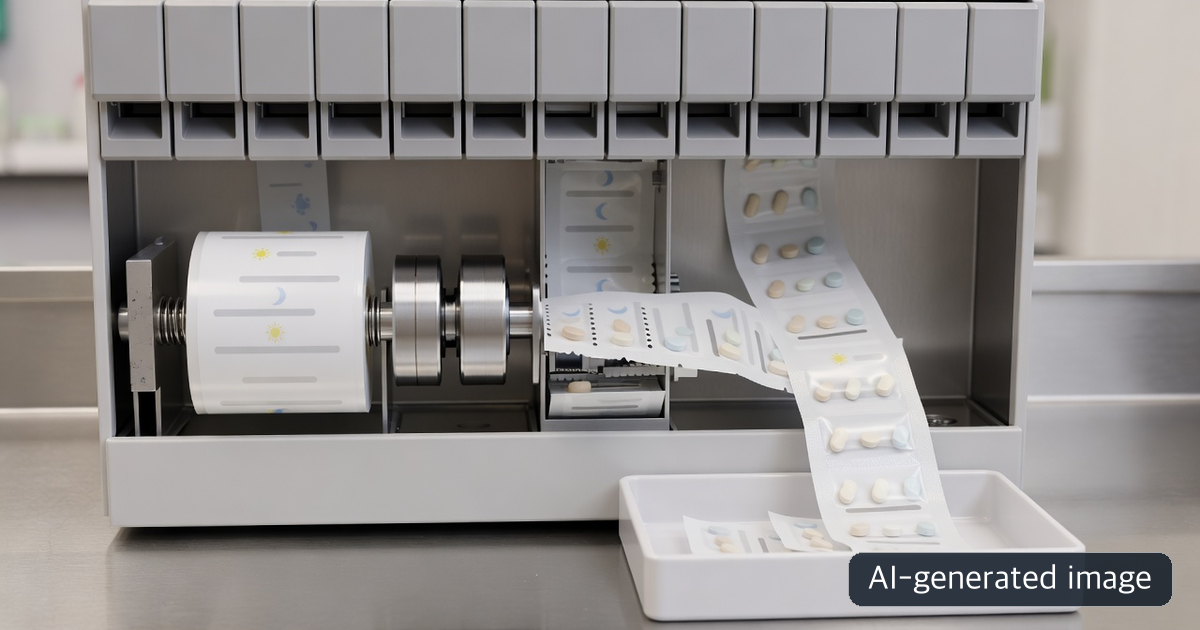
JVM’s 2025 third-quarter report filed through the Korea Exchange describes its ATDPS as automatically managing, sorting, distributing, and packaging medicines from prescription information and printing administration information on each bag.
The company reports a European sales subsidiary and supply to 60 countries through 34 partners. These are company-reported figures in an exchange filing, not independent evidence of a particular global market share.
The bounded conclusion is that Korea has an industrial base that develops and exports equipment for administration-time pouch workflows.
Which is safer: an original pack or a one-dose pouch?
The answer depends on the medicine and the patient.
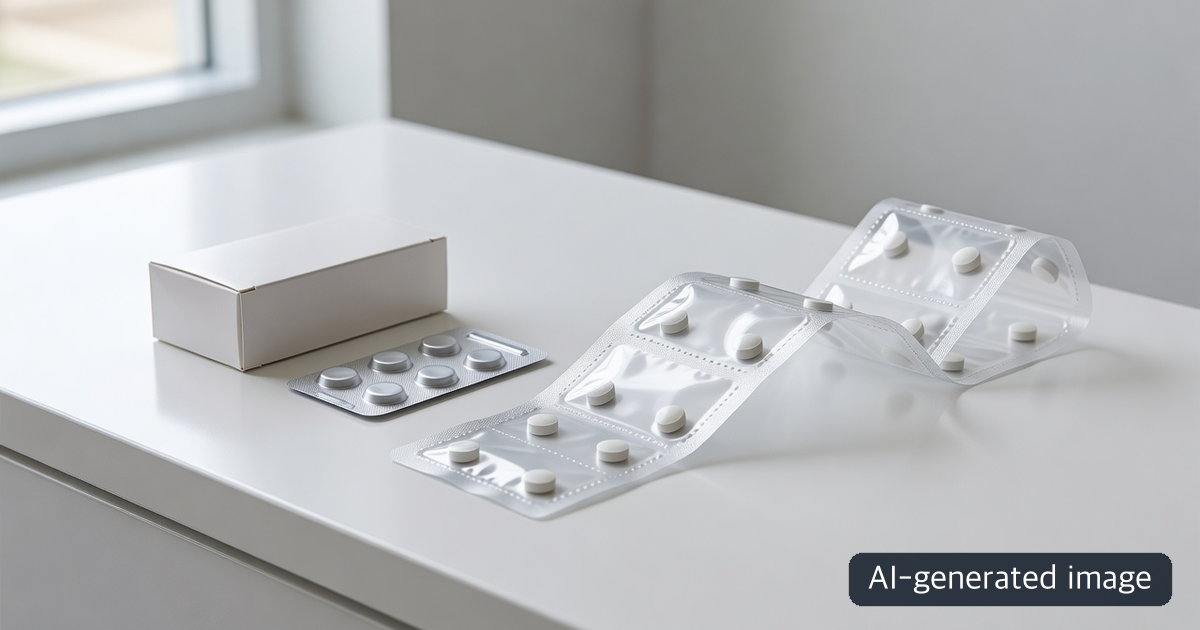
Why the original pack can matter
- Manufacturer labelling and the patient information leaflet remain together.
- Product name, strength, lot, and expiry information are easier to retain.
- Protection designed for products sensitive to light or moisture remains intact.
- Product identification may be easier during a recall or prescription change.
When administration-time pouches can help
- A complex regimen is difficult to organise.
- Medicines need to be arranged into morning, noon, evening, or bedtime units.
- A patient has difficulty removing medicine from packaging or needs medication-management support.
- The pouches are paired with professional review and counselling.
Some medicines may require original packaging or specific protection from light, moisture, or temperature. Patients should not combine products on their own; suitability should be checked with a pharmacist.
Evidence does not support a universal promise
A 2013 systematic review found that automated dose dispensing might reduce discrepancies in medication records. However, only seven studies met the review criteria, none was a randomised controlled trial, and the authors concluded that evidence on appropriate use, safety, and costs was limited.
A Dutch incident-reporting study found that reported automated-dispensing incidents often occurred while entering prescriptions into the pharmacy system or filling the bag. Medicine-regimen changes and patient relocation were frequent immediate causes. Percentages within a reporting system are not population risk rates.
A small qualitative study based on nine interviews found that automated dispensing alone did not automatically eliminate non-adherence, improve medication understanding, or remove old medication stockpiles from the home.
Automation should support pharmacist judgement, not replace it.
Seven questions for the patient
- [ ] Do I know the name and purpose of each medicine?
- [ ] Do I understand the administration time and any before/after-meal condition?
- [ ] Do I know what to do if I miss a dose?
- [ ] After a prescription change, have I stopped relying on the old pouches until they are reviewed?
- [ ] Does any medicine need to remain in its original pack?
- [ ] Have I checked light, moisture, and temperature storage instructions?
- [ ] Have I discussed interactions with other medicines or supplements?
Individual dosing and storage instructions from the prescriber and pharmacist take priority. Do not share another person’s pouch or combine medicines without professional confirmation.
Korea’s advantage is operational, not the pouch itself
US vials show the importance of child-resistant access and quantity-based dispensing. UK original-pack policy highlights manufacturer information and the patient leaflet. Japan’s one-dose service is tied to medication-management needs.
Korea’s practical advantage is the connection of review, real-time safety checks, counselling, and organisation around the patient’s daily administration schedule.
That advantage remains safe only when convenience is balanced with product identity, protective packaging, prescription-change review, and pharmacist counselling.
Checked: 20 September 2026 KST
About the Author
Life Table of Contents Editorial Team
References
- Daily Soul English, Why the US uses pill bottles while Korea uses pouches
- US CPSC, Poison Prevention Packaging Act Business Guidance
- US FDA, Promoting Safe & Effective Drugs for 100 Years
- UK Government, Original pack dispensing consultation response
- Japan MHLW, 2022 dispensing-fee reform material
- Korean Law Information Center, Pharmaceutical Affairs Act Article 2
- Korean Law Information Center, Pharmaceutical Affairs Act Article 24
- Korean Ministry of Health and Welfare, Implementation plan for separation of prescribing and dispensing
- HIRA, DUR service procedure
- HIRA, My Medicines at a Glance
- HIRA, 2026 health-insurance benefit fee book
- Korea Exchange filing, JVM third-quarter 2025 report
- PubMed, Automated dose dispensing service: a systematic review
- PubMed, Medication incidents related to automated dose dispensing
- PubMed, Impact of automated dose dispensing on compliance and understanding
- Read the Naver version